The Next Quest for the Historical Formation of the Canon
Conference Date: 9–10 April 2026
Due Date for Proposals: 1 Dec. 2025
Venue: University of Pretoria, Pretoria, South Africa
Description:
Every student of the New Testament is already well familiar with the conventional story of the development of the canon of the New Testament: it is the story of the linear unfolding of ever greater recognition of the authority of those writings ascribed to apostolic origins alongside discernment of dissenting traditions (a.k.a. apocryphal and heretical), from the apostolic era until the big councils of the fourth and fifth centuries where the question of the canon was laid to rest, conventionally dated to the Thirty-Ninth Paschal Letter of Athanasius in 367 CE. According to this conventional narrative, aside from the criterion of apostolicity, the process of canon formation was shaped by – and in answer to – the formation of the Old Testament canon of scriptures (and thus the growing differentiation from early Judaism), and the challenges of Marcionism, Montanism, and Gnosticism with their divergent claims to authoritative revelation and truncated or expanded revelatory traditions.
The canon of apostolic writings (that only later came to be known as “New Testament”) is further intimately connected to how the formation history of Christianity is conceived – they furnish the contents and the framework for writing the history of early Christianity. However, in the recent past the conventional picture of the birth of Christianity and its adolescent years has been upended. Across a number of focal domains, discourses have emerged that contest the conventional picture of canon formation and the primacy of the canon as foundation or presupposition in New Testament interpretive practices. Some of these domains include:
Recognition of the essentially polemical, apologetic, and rhetorical character of our sources, both the primary source material (the early Christian writings) and the early Christian histories, as well as secondary scholarly literature on the formation of the canon. This goes hand in hand with the impact of revisionary, critical historiography – the fruit of contemporary critical theories of history and historiography. Just as the source materials – and secondary scholarly literature – do social, cultural, and ideological work, so do our manuscripts in their materiality, and hence …
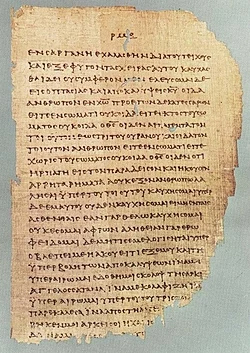
Reassessments of the material remains of the emerging tradition: the difficulties in dating early Christian manuscripts and thus of the status of the “historical factualities”; the fragmentary nature of the evidence; the complex material-textual histories of manuscripts, including writings of early Christian theologians; the complexities regarding collections of Christian writings; the emergence of New Philology as focus on the character and use of individual manuscripts instead of on some abstract (ahistorical) reconstructed text. In this vein, it also considers the emergent canonical collections within the context of the “bookishness” of early Christian social formations, and so in turn, revisions the relation between the writings later labelled the canonical New Testament and the flowering of a vast industry of written tradition-making characteristic of the first Christian centuries. These questions are not independent from considerations of the use-value of material textual artifacts in communicative interactions, network building, and authority construction. This creates the space for …
Perspectives, theoretical frameworks, and disciplinary practices from other study fields as lenses through which to conceptualise the phenomenon of canon formation and the functions of canons, to wit, history of religion and comparative religion; theory of religion; inventions of tradition and tradition formation; theories of identity constructions; critical theory; discourse theory; cultural anthropology; and literary theory, to name a few. Theoretical frameworks deriving from other study fields redefine the study of the history of the formation of the canon as multi-, inter-, and transdisciplinary.
But the study of the canon is not only oriented to the history of its formation. It also entails incorporating considerations of the functions of the canon in contemporary theological and exegetical praxis, as well as the various ways in which canonical authority operates in contemporary Christian religious formations. This includes the social histories of the canon – and the various canons other than the accepted Western New Testament canon, so as to provincialise our current conventional accepted canon as a Western European importation.
Call for Papers:
Paper proposals are invited that are not merely descriptive and repetitions or restatements of the conventional picture of canon formation, but significantly engage with the areas of critical analysis and theorising outlined above. That is, paper proposals are invited that critically think through the phenomenon of the canon of the New Testament and its formation. This also includes papers that engage in detailed analysis of texts, authors, and manuscripts with a view to critically conceptualise their place in the historical formation of the New Testament canon.
Paper Proposals:
Please submit paper proposals by 1 December 2025 to both:
Gerhard van den Heever, vandenheevers@lantic.net
Chris de Wet, chris.dewet@up.ac.za
 Greco-Roman Religions